
lifestyle
Life Support in Japan
Studying in Japan can come with many challenges due to language barriers and cultural differences.
At Waseda EDU Japanese Language School, Oji Campus, we not only provide Japanese language education, but also offer comprehensive support for students’ daily lives—from finding housing and handling administrative procedures to accompanying students to hospitals when needed.
Our experienced faculty and staff are dedicated to supporting each student with care and warmth, like a family, so that you can focus on your studies with peace of mind, even if it is your first time living in Japan.
From small questions to emergency situations, we are always here for you, fully committed to helping you enjoy a fulfilling and successful study abroad experience.
Daily Life
About Personal Seals (Hanko)
In daily life in Japan, you will have many occasions to use a personal seal (hanko), such as when opening a bank account or signing a rental contract.
Nowadays, simple seals can be purchased online, and handmade seals are also available at specialty shops. Since a hanko is used in place of a signature, it is important to keep it safe once you have made one. Basic seals can be made for as little as around ¥1,000.
The history of personal seals in Japan dates back approximately 2,300 years, when they were introduced from China. It is interesting to see how this tradition remains deeply rooted in modern Japanese life.Resident Registration
Students who will stay in Japan for more than three months, including those enrolled in long-term programs, must complete resident registration at the local ward office or city hall within 14 days of arriving in Japan.
Health Insurance
Like resident registration, the procedure for health insurance is completed at your local ward office or city hall. Please complete this process on the same day as your resident registration.
In Japan, foreign residents are also recorded in the Basic Resident Register. Those who are not enrolled in employee health insurance and who plan to stay in Japan for more than three months are required to join the National Health Insurance system.
When applying, be sure to submit a “Simple Tax Declaration Form” to report your income from the previous year.
<Required Documents for Registration>
・Residence Card
・Designation Form (only for those with the “Designated Activities” residence status; this form is attached to your passport)Student Insurance for International Students
Students enrolled in long-term programs at our school are automatically enrolled in the “International Student Insurance” provided by the Japan Language School Cooperative Association, which is approved by the Ministry of Education, Culture, Sports, Science and Technology (MEXT).
Under the National Health Insurance system, 70% of medical expenses are covered, and students are responsible for the remaining 30%. By submitting the receipt for this 30% payment to the school and applying for the International Student Insurance, the remaining cost will be reimbursed. This means that your out-of-pocket medical expenses can effectively be reduced to zero.
In addition, this insurance covers various situations not included in National Health Insurance, such as liability for injuries caused to others while riding a bicycle, or travel expenses for family members to come to Japan in case of a serious accident.
Please note that treatments related to dental care, mental health, chiropractic care, pregnancy, and childbirth are not covered.Opening a Bank Account
If your period of stay is more than three months, you can open a Japan Post Bank (Yucho Bank) account shortly after arriving in Japan.
Please note that accounts at other banks can generally only be opened after you have been in Japan for at least six months.Required Documents for Opening a Bank Account
Required Documents:
1. Residence Card
2. Passport
3. Student ID (or Certificate of Enrollment)
4. Residence Certificate
5. Personal Seal (Hanko)
6. Japanese Mobile Phone Number
7. Address in Japan
Housing
About Housing
The rules for renting a room in Japan can be quite different from those in other countries and may be complicated. For this reason, we highly recommend staying in our student dormitories.
If You Choose to Search for Housing Through Our Partner Real Estate Agency
Our school works with partner real estate agencies and can help you find housing that meets your preferences. These agencies generally offer furnished rooms, including beds and basic furniture.
Before moving in, you are required to pay a service fee and three months’ rent in advance. From the fourth month onward, you will need to pay the rent directly to the real estate agency.
Bedding such as futons and mattresses can be purchased upon request. Applications can be made from two months prior to your desired move-in date.
Finding Housing on Your Own
When renting a room in Japan, you may be required to pay additional costs besides the monthly rent, such as a security deposit, key money, and an agency fee. In particular, “key money” can be confusing for foreigners, as it is a non-refundable payment made to the landlord as a gesture of appreciation.
The security deposit is similar to a deposit in other countries, but it may be used to cover cleaning or repair costs, such as replacing tatami mats or hiring professional cleaning services. These expenses will be deducted from the deposit.
In Japan, most rental properties are unfurnished. In many cases, only an air conditioner is provided. It is important to consult with a real estate agency when searching for a room.
The average rent near the school is approximately ¥70,000 to ¥80,000 per month for a one-room apartment.
Utility Bills
You need to contact each utility provider (electricity, gas, and water) separately. Be sure to confirm the necessary procedures with your real estate agency or landlord. Bills are issued monthly, and payments can be made at convenience stores.
For properties introduced by our partner real estate agencies, utility and internet fees are often included in the rent.How to Dispose of Garbage
Garbage disposal rules in Japan are strict. In some areas, you are required to use designated garbage bags only. When renting a room, be sure to ask your real estate agency or landlord about the local garbage disposal rules. There are also specific rules in student dormitories, so please make sure to follow them.
In Kita City, guidelines on how to separate and dispose of household waste and recyclables are available (in Japanese, English, Chinese, Korean, and Bengali):
https://www.city.kita.tokyo.jp/r-seiso/kurashi/gomi/bunbetsu/chirashi/index.html
Communication & Electronics
About Mobile Phone Contracts
Foreign residents who have a residence card can sign up for mobile phone services in Japan. These services are broadly divided into three categories: major carrier plans, low-cost SIM cards, and budget smartphones.
Japan’s major mobile carriers include NTT Docomo, au, and SoftBank. Each company offers a wide range of services, so it is important to research carefully before signing a contract.
Monthly communication fees can range from around ¥1,000 to over ¥10,000. Please choose a plan that best suits your needs.
About Voltage
Japan uses a relatively low voltage of 100V. To use electrical appliances from overseas in Japan, a step-up transformer may be required. However, not all appliances can be used even with a transformer, so please make sure to check compatibility carefully before bringing them to Japan.
Most electrical appliances are also available for purchase in Japan.
About Power Plugs
In Japan, the most common type of plug is known as Type A. This plug has two flat, parallel pins.
The electrical frequency in Tokyo is 50 Hz, and the voltage is 100V.
Transportation
Public Transportation Information
Tokyo has more than 700 train and subway stations, with a total of 85 railway lines. In addition, there are 131 Toei bus routes operating within the city. As a result, many Tokyo residents use public transportation for commuting to school and work.
About Transportation IC Cards
To use public transportation, it is convenient to use transportation IC cards such as “Suica” for JR lines and “PASMO” for subways. While you can also purchase tickets, using Suica or PASMO is much more convenient. Both cards can be purchased at stations and can be used on all public transportation within Tokyo. When purchasing a card, registering your name, date of birth, and phone number allows you to have it reissued in case it is lost. For more details, please inquire at the station. There are also Mobile Suica and Mobile PASMO apps available for use on smartphones.
Accidents & Disasters
Preparing for Emergencies
Japan is a country prone to natural disasters, particularly earthquakes, tsunamis, and typhoons. Our school conducts annual disaster prevention drills, including hands-on experiences such as earthquake simulation and fire extinguishing training. All students are required to participate in these activities to raise their awareness of disaster preparedness.
In Case of an Earthquake
Earthquakes can occur at any time. It is recommended to install an earthquake alert app on your mobile phone. Preparing for power outages is also important, so make sure you have a flashlight and a fully charged portable battery.
It is also advisable to prepare an emergency kit in advance, including items such as food, medication, rain gear, clothing, gloves, small change, and plastic bags. As Japan experiences frequent earthquakes, various emergency supplies—such as waterless shampoo—are widely available. We recommend checking these items after arriving in Japan.
What to Do During a Typhoon
Typhoons are most common from July to October. It is recommended to install a weather alert app on your mobile phone to receive typhoon updates.
<Recommended Items to Prepare>
It is important to be prepared for power outages. Make sure you have a flashlight and a fully charged portable battery. It is also advisable to prepare an emergency kit in advance, including items such as food, medication, rain gear, clothing, gloves, small change, and plastic bags.In Case of an Emergency
In case of a crime or accident, be sure to call the police. The police emergency number is 110.
In case of a fire, sudden illness, or serious injury, call the fire department. The emergency number is 119.
If you are unsure whether to go to the hospital or call an ambulance, please dial #7119. You will be connected to the Tokyo Fire Department Emergency Consultation Center, where you can receive advice on what to do.
When making a call, please stay calm and clearly state your name, your current location, and what has happened. If you have difficulty speaking Japanese, ask a nearby Japanese person for assistance.The Day of the Major Earthquake in Japan
Every country has important days that should never be forgotten. In Tokyo, where our school is located, significant damage was caused by the Great East Japan Earthquake on March 11, 2011. The Great Hanshin-Awaji Earthquake struck the Kansai region on January 17, 1995, and the Great Kanto Earthquake occurred on September 1, 1923.
In Japan, September 1 is designated as Disaster Prevention Day, when disaster drills and other activities are conducted to raise awareness. After arriving in Japan, be sure to check your evacuation routes as soon as possible, and take the opportunity on Disaster Prevention Day to review your emergency supplies.
Important Symbols to Know
Please make sure to remember these three symbols.
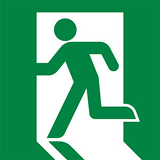
Emergency Exit
This symbol indicates an emergency exit. It shows the direction to evacuate the building in case of an emergency.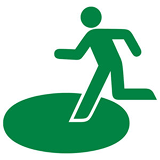
Evacuation Area
This symbol indicates a designated evacuation area, a wide open space intended to protect people from large-scale disasters such as earthquakes and fires.